Return to the ARFRR website

Disclaimer & Content Usage

The ideas and views expressed on the ARFRR blog are solely those of the post authors. You may cite our posts and content, if you attribute it to us.

Tuesday, April 25, 2023

Town Meeting Members' Guide to Important Articles - 2023

Town Meeting Members' Guide to Important Zoning Articles - 2023


Arlington Residents For Responsible Redevelopment, a grassroots group of neighbors, first created our Resource and Comment Guide for 2019 Town Meeting, when the Town proposed sweeping density Articles.  Our goal, then as now, is to provide Town Meeting Members and all Arlington residents with information on the substantive issues that will be discussed during Town Meeting, as well as our comments.  We hope the information below is useful to you.  

Please let us know your thoughts on it at: askarfrr@outlook.com


OVERVIEW:

Town Meeting begins April 24, 2023, in Town Hall sessions.  The public may attend.  Click here to watch live: https://acmi.tv/programs/arlington-government-channel/

Town Meeting receives proposed Articles inserted either by a resident with 10 supporting resident signatures, or by Town officials or boards.  Each Article is reviewed by the Town Board relevant to the scope of language.  All proposed zoning changes are subject to approval by the Arlington Redevelopment Board (ARB) following a public hearing on each zoning article.  If the Board votes in favor, it develops a recommended vote to Town Meeting, which constitutes the main motion on the article.  A Town Meeting Member acting on behalf of the proponent, another interested party, or TMMs themselves may move an Amendment (change) to the recommended vote of the ARB, or they may move to replace it in its entirety with a Substitute Motion.  If the Board disapproves of the article, it votes “No Action” as its recommended vote for Town Meeting, which essentially removes the Article from likely passage by Town Meeting without much, if any, debate.  In that case, the proponent or other interested party may make a Substitute Motion, in order for Town Meeting to be able to have a zoning change to debate and vote on.  The deadline for Substitute Motions video presentations this year was April 19.  Substitute Motions may be presented no later than 48 hours before an Article is discussed. 

Where to find Articles:
Articles are listed by number, in the annotated TM warrant, which contains links to all committee Reports and supporting materials: 
https://www.arlingtonma.gov/town-governance/town-meeting/2023-town-meeting-warrant

We have selected some of the more consequential Articles, and present them along with background and recommended vote.  This Guide covers the following Town Bylaw and Zoning Bylaw Articles:

ARTICLE 12 VOTE/THREE-YEAR MORATORIUM ON INSTALLATION OF ARTIFICIAL TURF ON TOWN LAND

To see if the Town will vote to adopt a moratorium by bylaw or otherwise, on the construction or installation of any artificial or synthetic turf on any land owned by the Town for a three-year period beginning on May 1, 2023 and ending on May 1, 2026 to allow further study of the cost effectiveness, safety, environmental impact; and further to establish a study group to conduct such study, and set forth the membership of same; or take any action related thereto.  (Inserted at the request of Beth Melofchik and ten registered voters)

RECOMMENDED VOTE: 

Please vote to SUPPORT Beth Melofchik's Substitute Motion:  

https://www.arlingtonma.gov/home/showdocument?id=64915&t=638174039974168194


Article 12 Substitute Motion
A Reasonable Response to the Public Land Management Plan

"Rapidly developing science and data on PFAS and climate change urges caution on introducing more PFAS into our environment.  The EPA and leading peer reviewed articles agree on this.  Laminating sports fields with plastic, rendering 2 acres void of nature’s benefits to the players on plastic fields, and creating a dead empty zone above and below for pollinators and soil microbes etc is not recommended.  We ask Town Meeting to allow a committee to explore the documented health and environmental hazards of this plastic product made of many chemicals with documented side effects and dangers.  And, while they research, a pause of up to two years on further purchase/installation of plastic fields.

"Our list of resources does not include apologists for the plastic sports field industry; it does include physicians and scientists at Boston College, Icahn School of Medicine Mt. Sinai, University of Massachusetts, Ecology Center, Public Employees for Environmental Responsibility, Sierra Club and others.

"We share knowledge, not propaganda or sales memes.  We want safe playing fields; free is not safe."
-- proponent Beth Melofchik


ARTICLE 13 VOTE/APPOINTED TOWN CLERK

To see if the Town will vote to convert the office of Town Clerk from an elected to an appointed position through ballot question or referendum pursuant G.L. c. 41 §1B, home rule legislation, or other suitable method; or take any action related thereto. (Inserted at the request of the Town Manager)

RECOMMENDED VOTE:

Please vote AGAINST this Amendment. We do not support the Article, or any Substitute Motion.
The Clerk's office is involved with the most political of Arlington's actions: voting, Town Meeting organization and support, and many other organizational duties.   The office has always been elected so that residents can be sure that the Clerk's work is carried out for them.  Town government has few other elected officials, other than the five volunteer Select Board Members.   We believe that continuing to allow residents to elect our Town Clerk, rather than allowing the Town Manager to make this appointment, is the best way to serve the Town's needs.


ARTICLE 67 RESOLUTION/AFFORDABLE HOUSING OVERLAY

To see if the Town will vote to adopt a resolution affirming affordable housing overlay districts; or take any action related thereto. (Inserted at the request of Guillermo Hamlin and ten registered voters) 

Please vote AGAINST this Resolution. We do not support the Article.
A similar version of this amendment was voted No Action at a previous Annual Town Meeting because the Redevelopment Board felt it overlapped with other plans. The Town is in the process of figuring out how to comply with the MBTA Communities Act, which will mean creating overlay districts, with which this may conflict.


The zoning amendments in this year's Warrant are:

ARTICLE 26 ZONING BYLAW AMENDMENT/ INDUSTRIAL DISTRICT DEVELOPMENT STANDARDS

To see if the Town will vote to amend the Zoning Bylaw to update Section 5.6.2 DEVELOPMENT STANDARDS to establish the design storm or other criteria that must be met for stormwater retention and treatment to receive an exception to maximum height regulations in the Industrial District; or take any action related thereto. (Inserted at the request of the Redevelopment Board)

RECOMMENDED VOTE: 

Please vote to SUPPORT this Amendment


ARTICLE 27 ZONING BYLAW AMENDMENT/ SOLAR BYLAW IN INDUSTRIAL DISTRICTS

To see if the Town will vote to amend the Zoning Bylaw to update Section 5.6.2 DEVELOPMENT STANDARDS to reflect the inclusion of Section 6.4 SOLAR ENERGY SYSTEMS; or take any action related thereto. (Inserted at the request of the Redevelopment Board)

RECOMMENDED VOTE: 

Please vote to SUPPORT this Amendment


ARTICLE 29 ZONING BYLAW AMENDMENT/DOWNTOWN BUSINESS PARKING MINIMUMS

To see if the Town will vote to complete removal of minimum parking requirements for all non- residential uses in the B-5 District, or take any action related thereto. (Inserted at the request of James Fleming and ten registered voters)

RECOMMENDED VOTE:

Please vote AGAINST this Amendment. We do not support the Article, or any Substitute Motion.
This amendment is completely unnecessary.  Every affected lot is already required to be reviewed before the ARB for any redevelopment and major changes (with a single exception of a building on Water St.).

It eliminates the discretion of the ARB and ZBA.  What if there is not enough space in the public lots at the times the business needs them?  Consider what might happen if a large business requires a great deal of parking at the same time the Arlington Farmer's Market is taking place.  This warrant article would eliminate any power of the ARB or ZBA to require the business make alternative parking arrangements.

It privileges B5 business (Arlington Center) over businesses in other zoning districts (e.g. B3 and B1 that are also within 1000' of the public lots).  Why should those businesses, which likely have smaller parking needs, have to get a Special Permit to count spaces in the public lots, while the largest businesses, those in B5, do not?

The ARB always grants parking reductions or elimination, based upon the particular circumstances.  But they also extract a small concession in return from the developer, in the form of the Transportation Demand Management plan.  This usually involves some compensatory benefit for employees, such as subsidized T passes or a guaranteed ride in case of emergencies.  Without these TDM concessions, commuting employees will be the losers.

This article may also be in conflict with the Americans with Disabilities Act.  


ARTICLE 30 ZONING BYLAW AMENDMENT / ONE AND TWO-FAMILY USABLE OPEN SPACE

To see if the Town will vote to complete removal of the Usable Open Space requirements for one and two-family uses; or take any action related thereto. (Inserted at the request of James Fleming and ten registered voters)

RECOMMENDED VOTE:

Please vote AGAINST this Amendment. We do not support the Article or any Substitute Motion.  
Article 30 proposes to completely eliminate the usable open space (UOS) requirement for single- and two-family homes in all districts. 

The proponent uses nearby towns with no UOS requirement as comparisons. But Lexington, Belmont, Winchester, and Waltham all have much larger minimum lot sizes than we do, as well as much lower population and housing density.  And the city of Cambridge requires far more "private open space" (which is defined similarly to UOS) than Arlington does for one and two-family homes.

Our UOS requirement generally has little effect on large lots, but it serves as a brake on overly large houses on small lots, and is one of the tools recommended by our Master Plan, to “address concern for neighbor impacts of new large homes constructed in existing established residential neighborhoods.”   In addition, the Master Plan describes Arlington's existing residential development standards, including UOS, "as reasonable and consistent with prevailing development patterns in the neighborhoods."

Eliminating UOS would allow back yards to be paved over completely to create parking lots for the residents.  And it could be done by-right, with absolutely no requirement for approval by the ZBA or ARB.  We already see this happening at times in East Arlington, where backyards on smaller lots are converted to parking lots without permission, much to the detriment of abutters.  We should not be amending the bylaw to routinely allow this practice.

Houses don’t exist in a vacuum. Especially in Arlington with its many non-conforming and small 5,000 SF lots, what your neighbor does can have a large effect on you, and vice versa. 

The Master Plan also cites the particular need for UOS in residential development in business districts, calling it “critical” in our village centers. Extending the elimination of UOS for one and two-family homes to all of our business districts, as the amendment proposes, makes it economically preferable to convert entire small business blocks along Mass Ave or Broadway into duplex condos. This article directly threatens these small neighborhood businesses that make Arlington walkable and appealing.

We already have a mechanism to allow people to seek relief from our UOS requirement in order to build additions or new houses, and that is an appeal to the ZBA for a special permit. The ZBA will often allow some expansion for prior non-conforming lots with little or no UOS. 

Rather than eliminate usable OS, which would allow large houses to replace smaller, somewhat attainable homes, it would make more sense to simply amend the bylaw to reduce the minimum dimensions of UOS and to provide greater clarity on how it applies when floor area is added entirely within the existing building footprint.

ARTICLE 31 ZONING BYLAW AMENDMENT/INDUSTRIAL DISTRICT ANIMAL DAYCARE USE

To see if the Town will vote to amend the Zoning Bylaw to update Section 5.6.3 USE REGULATONS FOR MU, PUD, I, T, and OS DISTRCITS, to allow animal daycare; or take any action related thereto. (Inserted at the request of Kristin Anderson and ten registered voters)

RECOMMENDED VOTE:

Please vote to SUPPORT this Amendment.


"During the lock-down period of the COVID-19 pandemic, many Arlington residents were forced to stay home. To remedy intense loneliness, many of our neighbors decided to welcome new pets into their homes. Now that the pandemic restrictions have been lifted, people are going back into the office, leaving their pandemic pets at home. 

"Arlington is in need of animal daycare. To the best of my knowledge, there exists in town only one animal daycare business - GoPlay!, in Brattle Square. But GoPlay! Is small, with limited capacity.
Robin from Robin’s Nest Dog Grooming wanted to expand her business a few years back, to offer doggie daycare, and found a space in the Industrial Zone. But she was unable to grow her business and offer doggie daycare to residents because the use was not allowed there. Daria Pennesi, of Strut-n-pup, has been looking at spaces in Acton because she was not allowed to move into a space in the Industrial Zone on Dudley Street. Virginia, from Pawtopia - another woman-owned local business, has already moved her business to Lexington where there are more abundant commercial space offerings.

"This Industrial Zone use restriction has had a negative impact on these women’s ability to grow their businesses. The lack of available space is forcing  businesses out of Arlington. And, worse, it negatively impacts the residents of Arlington by denying them local services that they need. 

"Arlington needs to better support our businesses because businesses make Arlington a better place to live. We cannot grow our commercial base in town and realize any level of economic development without space for our businesses. I ask for your support and your vote for article 31."
-- proponent Kristin Anderson

Sunday, December 4, 2022

Broadway Blockbuster


Broadway Blockbuster


On December 19th, the Arlington Redevelopment Board (ARB) will continue its public hearing to approve the tallest building on Broadway in Arlington.  


Even if you don’t live near this development, here is why you should care:


·      It sets a new precedent for the height of mixed-use buildings in town—higher than what most residents deemed acceptable in Arlington’s latest Master Plan

·      It will block the views, sunlight, and solar panels of nearby homes, and the same thing could happen to you if you live near a commercial district

·      The Redevelopment Board is again allowing residential development without any usable open space, thereby violating the town’s Zoning Bylaw


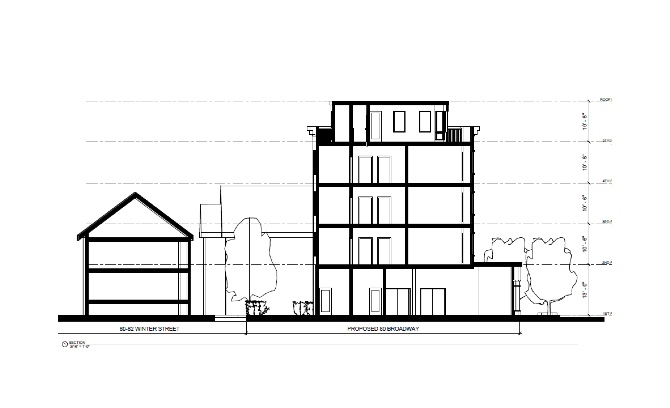
This 5-story, 55-foot mixed-use extravaganza will be located at the corner of Winter Street, surrounded by two- and three-family homes and low-density apartments, all of which are limited to 35 feet in height.  


The building will have no setbacks on two sides, and almost none on a third side.  And it will be on a lot not much larger than that required for a single-family home.


What’s wrong with this picture?  As shown in the plans submitted (extracted in the figures here), the development is completely out of scale with the Broadway neighborhood, as well as the two-family homes nearby.  And it covers almost the entire lot.


Winter Street Elevation


Building Footprint


The development violates Arlington’s Zoning Bylaw in numerous respects:


1.  The front yard setbacks are inadequate. Zoning Bylaw section 5.3.8 requires 20’ setbacks on both the Broadway and Winter street frontages. The plans, however, show no setback on Broadway and only 2’ on Winter St.


2.  The step-back for the top floor is non-compliant.  Zoning Bylaw Section 5.3.17 requires an upper story setback of at least 7.5’ along all street frontages for buildings in excess of three stories in height. No step-back is being provided along Winter St. 


3.  The proposal lacks any usable open space.  Zoning Bylaw section 5.3.21.D requires usable open space equal to at least 20% of the residential floor area.  The proposal contains no open space that meets the definition of usable. 


The proposal also violates at least two other standards needed for its approval:


1.  Due to its location near lots zoned and used for 2-family homes, it is limited in height to at most 4 stories and 50 feet unless the ARB finds those properties would “not be adversely affected due to existing use or topographic condition.”


Since neither the existing use nor the topography can be considered mitigating in this case, and it has been shown that the solar panels two houses away will be adversely affected by the 55’ building, the ARB cannot possibly make the necessary finding.


2.  Projects subject to Environmental Design Review by the Redevelopment Board, as this one is, are supposed to go through a higher level of review. Standard 3.4.4.B requires that they relate harmoniously to the scale and architecture of existing buildings in the vicinity.  This proposal does neither.


So how can the ARB approve a project that violates Arlington’s Zoning Bylaw in so many ways?


Relying on a deeply flawed memo written by Arlington’s Town Counsel in 2020 (to rationalize the approval of other projects with zoning violations), the ARB claims it has the authority to waive requirements of the bylaw when it sees fit.


This claim is made by no other Planning Board in Massachusetts and is completely contrary to Massachusetts state law, the associated case law (see: Colabufalo v. Board of Appeal of Newton 143 N.E.2d 536, 336 Mass), and Arlington’s Zoning Bylaw.


An exception to local zoning requirements is a variance.  And the only board in town (in any city or town in Massachusetts) that can grant a variance is the Board of Appeals.  In a departure from past practice, the current ARB has decided it is special and doesn’t need to refer projects to Arlington’s Zoning Board of Appeals (ZBA) for a variance.  


Why would it adopt such a position?  It is nothing personal against the ZBA.  The ARB knows that in order to obtain a variance, specific conditions in state law must be met.  In practice, these conditions are very difficult to meet, meaning that variances can often be overturned if appealed.


Rather than trouble itself in observing legal niceties, the ARB does what it wants to: give mixed-use projects its approval, and leaves it to the abutters to go to court if they don’t like it. 


Will this happen with 80 Broadway?  Stay tuned.  You can catch the drama at 8:30 p.m. Monday, December 19, 2022 at the ARB’s continued public hearing on the project.  This in-person only meeting will be at the Arlington Community Center, 27 Maple St., Arlington, MA 02476.


Monday, October 31, 2022

Preserve the Woodlands at Hill's Hill

Barry the owl, seen at Hill's Hill  photo courtesy savehillshill.com


Preserve the Woodlands at Hill's Hill

contributed by Beth Melofchik

The Arlington Park and Recreation Commission (PRC) intends to create a mountain bike park at Hill's Hill, and clear the top of the hill for a pump track.  They have requested $400,000 for repurposing this woodland, replete with several types of native oak, shagbark hickory, big tooth aspen, and native cherry.  During climate breakdown is this the best use of this woodland?  Can Arlington afford to lose native trees on public land?  What are the high value trees?

An environmental impact study has not been done prior to PRC deciding to move forward with a Community Preservation Act funding request.  The location of Hill's Hill woods is in proximity to the  Mirak heat island and along the Mill Brook Linear Park.  Imagine Arlington Great Meadow heading east to the Reservoir, Hurd Field, Buck Field, Hills Hill Woods, Old Schwamb Mill, Wellington Park and on into Arlington Center.  This runs along the Minuteman Bike trail and Mill Brook.

Visit https://savehillshill.com to learn how you can take action.
Why is a luxury mountain biking park an inevitable build for Arlington?  They first tried to establish it in the historic Menotomy Rocks Park, then in Crusher Woods.  Neighbors and outdoor lovers, those with an understanding of passive recreation and the importance of access to woods and access to green space for all, organized and those parks were preserved.  Now Hills Hill Woods is on the drawing board for this bike park, at the behest of PRC.

The proposed Pump Track,  photo courtesy savehillshill.com
Has a market survey been done?  Why do we need a mountain biking park with a pump track?  Who will use it?  How much do mountain bikes cost? To what cohort of the population of Arlington would it cater?  Are there other sports fields serving this group?  Are there other parcels in town of a less strategic value to our tree canopy and habitat preservation?
Is there a better use of $400,000 of CPA funds when Arlington faces colossal overrides?
Has this project been reviewed by the Tree Committee, Sustainable Arlington, Clean Energy Futures Committee, and Open Space Committee for potential impact on extreme heat, storm water retention and habitat loss?  I remind the reader that Arlington offered the Reservoir beach with an entry fee and the splash park at the Thompson School as cooling centers last summer during periods of extreme heat.  Arlington needs all its shady spots, we cannot afford to lose access to any woodland.  Arlington needs trees absorbing storm water.

An image from the website of the project contractor

Trails are already being created at Hill's Hill without PRC authorization.  One excavation pit at Hill's Hill is 3 feet deep.  This is a hazard to birders, hikers, walkers, anyone out enjoying the sunshine and woodland.  An unknowing child on a bike could topple in or even someone's pet.   This hazard is on town owned land administered by PRC.
We may need to change how we live and consume.  Sustainable Arlington and the Clean Energy Futures Committee informs us of that, but we also simultaneously need to preserve what we have in our parks and green spaces for us and for our children and grandchildren.
Time out.  What is the best use of the woodland at Hills Hill?  

Tune in.   JOIN THE ZOOM CALL FOR THE CPA COMMITTEE, Wednesday Nov. 2, 6pm - 8pm

  • Date:11/02/2022 6:00 PM - 8:00 PM 
  • Location:Zoom Conference Call

Location: Conducted by Remote Participation 

Please register in advance for this meeting with this link:

https://town-arlington-ma-us.zoom.us/meeting/register/tZMsc-upqDwjEtQlKdik6go8GMDPlRWMpHFu

Agenda 

  1. Introductions
  2. Election of Officers
  3. Review and approval of minutes
  4. FY24 projected CPA revenues
  5. Discussion of FY24 CPA Preliminary Applications received
  6. Vote: Inviting FY24 Final Applications
  7. Other business.

Thursday, April 14, 2022

GUIDE TO THREE ZONING ARTICLES FOR 2022 ANNUAL TOWN MEETING

A number of zoning Articles are before Annual Town Meeting this year, and of those endorsed by the Arlington Redevelopment Board (ARB), we support or are neutral on many.  However, we oppose the three Articles discussed below, and hope you will contact your Town Meeting members and ask them to vote No on Articles 38, 39, and 41.  See below for contact information, letter template, talking points, etc.


ARTICLE 38

ZONING BYLAW AMENDMENT/TWO FAMILY CONSTRUCTION ALLOWED BY RIGHT IN R0 AND R1 RESIDENTIAL ZONES

Article 38 would allow two-families by right in R0 and R1 districts, ending single-family zoning.  So far, a revised motion from the Arlington Redevelopment Board and a citizen's amendment have been submitted.  The revised motion would limit the size of each duplex unit to 1,850 square feet of heated living space; and the Newton amendment would allow construction of larger units as long as the portion greater than 1,850 square feet is unheated for the first three years.  The amendment opens up all kinds of loopholes for developers.  Under the ARB restriction, the principal structure, excluding any ADUs, was limited to 3,700 square feet in two and a half stories.  The Newton amendment opens the door for a developer to put that 3,700 square feet into the first two floors, with another "unheated" 925 square feet into the upper half story.  All of the floors could be finished and air-conditioned, and so used for many months of the year, but the upper half story could not be "legally" heated for the first three years.  Each condo would be 2,300 square feet, likely selling for $1.2M or more.  The entire structure could be a massive 4,625 square feet, larger than all but 40 single family homes in R1.  

We recommend a no vote on Article 38, and all amendments, for the possible consequences mentioned above, and for the following reasons:  

♦ Unclear intent. 

The proponents have acknowledged that this Article it isn’t about adding more-affordable housing, but about providing “choice.”  Given that new duplex units are listing at $1M and up, this means choice for buyers who can afford those prices, not for the middle-and lower-income buyers whose options are much more limited.  Article 38 will do nothing to make Arlington more diverse, more equitable, or more inclusive. 


♦ Failure to meet ARB requests for supporting information.

A very similar Article was proposed in 2020.  At that time the ARB asked for comparative studies, and a plan for education and outreach.  Neither was provided.  This year the ARB made the same requests, and again, neither has been provided.  


♦ Lack of evidence that increasing market rate housing does anything to ameliorate the lack of attainable and affordable housing.  

The proponents provided two links to info from Minneapolis, where upzoning was enacted several years ago.  Both sources acknowledge that property values have since increased, but say nothing about the effect on attainable housing.  A body of research indicates that upzoning drives up nearby property values and draws higher-income buyers to communities with desirable amenities, such as Arlington.  Housing units enabled by Article 38 will not be affordable.  Low- and middle-income buyers trying to purchase a modest home will be outbid by developers who profit by replacing small affordable houses with two or more housing units.  This isn’t speculation: In every recent case where a single family has been demolished in an R2 district, each new duplex unit has sold for more than the demolished structure. 


♦ Unintended consequences.

A 900 sq. ft. Accessory Dwelling Unit is allowed to be added to each of the two 1,850 sq. ft. units in two-family houses (the size limit suggested in the ARB amendment to Article 38).  Article 38 actually enables four-family homes on each lot in a single-family district.  The size of such a structure could be huge, as much as 5,500 sq. ft.   


Article 38 will accelerate population growth, leading to an increase in taxes town-wide as increased costs of infrastructure, schools, services, etc. rise along with increasing population.  Multi-million dollar overrides will become more common.  Residents on fixed incomes, especially our older residents, will be hard hit. 


Article 38 would contribute to acceleration of climate change by exacerbating sustainability issues including tree loss, loss of embodied energy in teardown activity, and the large energy consumption of construction.  At the very least, new construction enabled by Article 38 should be required to be NetZero.


♦ Lack of endorsement.

Two members of the ARB have voted No Action on Article 38, citing concerns about a lack of coherence with a comprehensive plan, such as that recommended by our Master Plan.  The Master Plan Implementation Committee has likewise voted No Action. 

♦ Amendments to limit living space wouldn’t offset the negative effects

A maximum living space amendment would do little to prevent the harm this Article would cause, as most Arlington single family lots are 5-6,000 square feet. The units would still be built to the largest size and sales price possible, driving teardowns. Increase in load on services, schools, traffic and infrastructure would be the same.  And as allowed by the most recent amendment, the 1,850 square foot per unit restriction would be moot after three years. 

Allowing two-families in all residential districts by right should not be an experiment.  If enacted, it should be supported by studies, and should consider the input of affected property owners.  We urge you to ask your Town Meeting Members to vote NO on Article 38, and on the living space size-restricted Amendments. 


To learn more, please visit:


ARTICLE 39

ZONING BYLAW AMENDMENT/INCREASED FLOOR AREA RATIO FOR MIXED USE STRUCTURES 


Article 39 would allow mixed-use structures in our commercial districts to increase their Floor Area Ratio by an as-yet unspecified amount. The proponent suggested an increase of almost four times our current FAR, which is at least double that of similar communities; the ARB then recommended essentially a doubling of our current FAR for most instances.  We oppose Article 39 for the following reasons: 


♦ Lack of understanding of how FAR interacts with other regulations.

FAR is a complex calculation, and must take into account many aspects of a site’s particular limitations, including but not limited to Open Space requirements, allowed height, setbacks, etc.  The proponent has not presented comparative studies from other communities, or a justification for the change here. 


♦ Impact on struggling business districts.

In 2019 a Mixed-use Bylaw was passed which intended to drive renewal of our business districts by amending their allowed uses to provide larger structures and greater residential use.  The mixed-use projects that have been proposed and completed since then have instead created buildings that are almost entirely residential with token office space on the ground floor.  Allowing even larger mixed-use buildings will further the inroads of residential uses, and weaken our already struggling business districts, as well as encouraging enormous residential buildings without the parking, setback, or open space normally provided to residents of multi-unit buildings.  


Our business districts deserve better. We urge you to ask your Town Meeting Members to vote NO on Article 39 and an insufficiently researched "compromise"  FAR-doubling Amendment.


ARTICLE 41

ZONING BYLAW AMENDMENT/APARTMENT PARKING MINIMUMS 


Article 41 would reduce or remove the required parking space minimum per unit in apartment buildings.  We oppose it for the following reasons: 


♦ Impact on 2-car families.

We all want to work for a less car-dependent world, but we’re not there yet.  Many of the tenants of the apartment buildings affected by this proposal work jobs that are in locations, or that have hours, that make public transportation problematic for them.  Especially for those in East Arlington, parking is already limited.  Further, the ARB already has the power to reduce parking requirements in certain situations.


We urge you to ask your Town Meeting Members to vote NO on Article 41.


________________________________________


Town Meeting Members will vote on these Articles and others at our Annual Town Meeting, which begins April 25.  Please contact your Town Meeting Members and ask for their NO vote on Articles 38, 39, and 41, using these resources:


Find out what Precinct you live in:

https://www.arlingtonma.gov/home/showpublisheddocument/58918/637739538761300000


Find your Town Meeting Members’ email and telephone contact info:

https://www.arlingtonma.gov/home/showpublisheddocument/60527/637850149936870000


Send an email to Town Meeting Members, using link above.  

Start with the 12 in your precinct. 


Use our template for ideas on what to say:

http://template22.arfrr.org


Include the link to our flyer or download and attach Article 38 Flyer: 

http://flyer.arfrr.org


Call Town Meeting Members Using link above.

Start with your precinct, and get your friends and neighbors to call too.


Use our Article 38 Talking Points: 

http://talkingpoints22.arfrr.org