Return to the ARFRR website

Disclaimer & Content Usage

The ideas and views expressed on the ARFRR blog are solely those of the post authors. You may cite our posts and content, if you attribute it to us.

Thursday, April 8, 2021

Tossing Out the Rulebook, Part II: Targeting Capitol Square

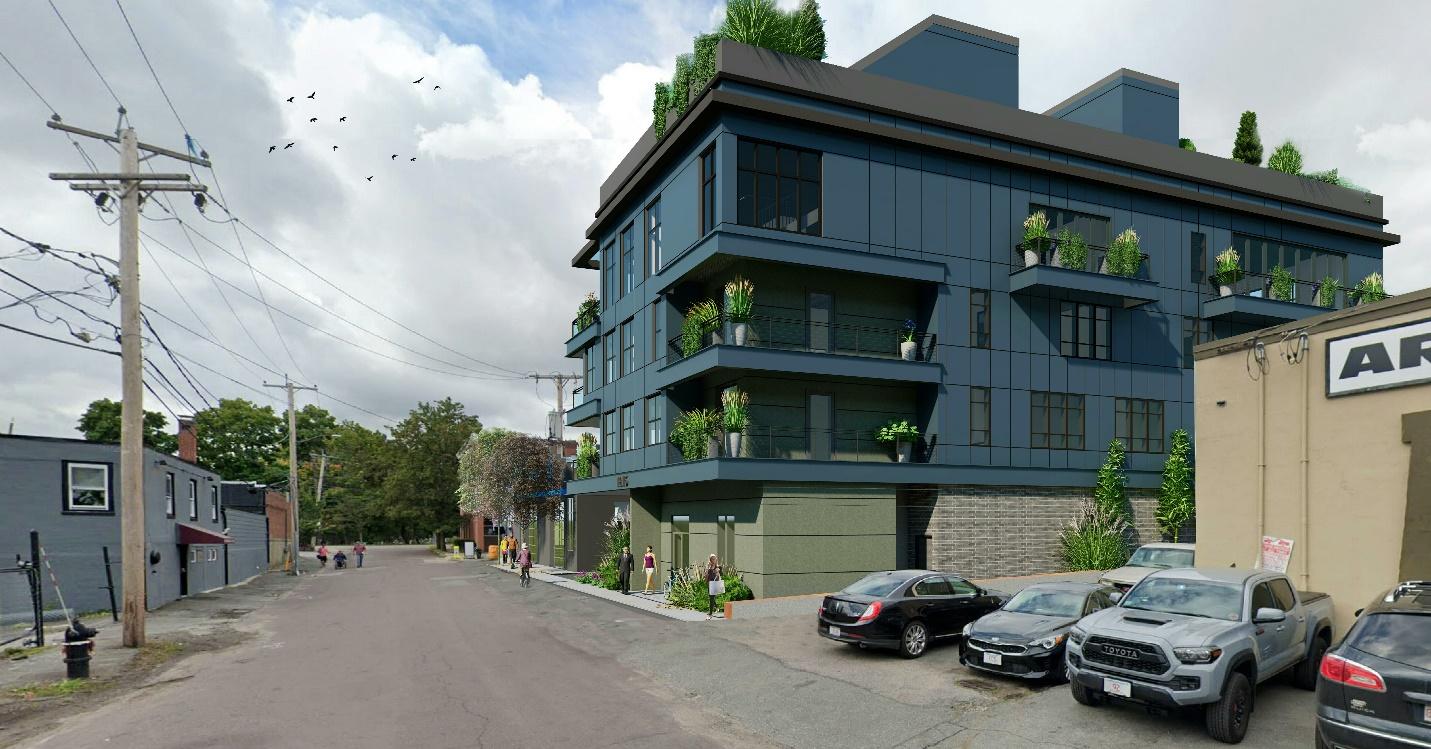
Imagine if you took the new building at 887 Mass. Ave., between Stop & Shop and the High School, and plopped it down on top of 190-200 Mass. Ave., the block that holds Little Q Hotpot, the former Flora restaurant, Christo’s market, etc.  Hard to picture?  No problem—the same team of owner/architect behind the demolition of the Toraya block, at 882-892 Mass. Ave., has done the work for you.  They are proposing to build a 5-story mainly residential building opposite the Capitol Theater that will jam together styles with nothing in common, as they continue their efforts to transform commercial sites into residential. 
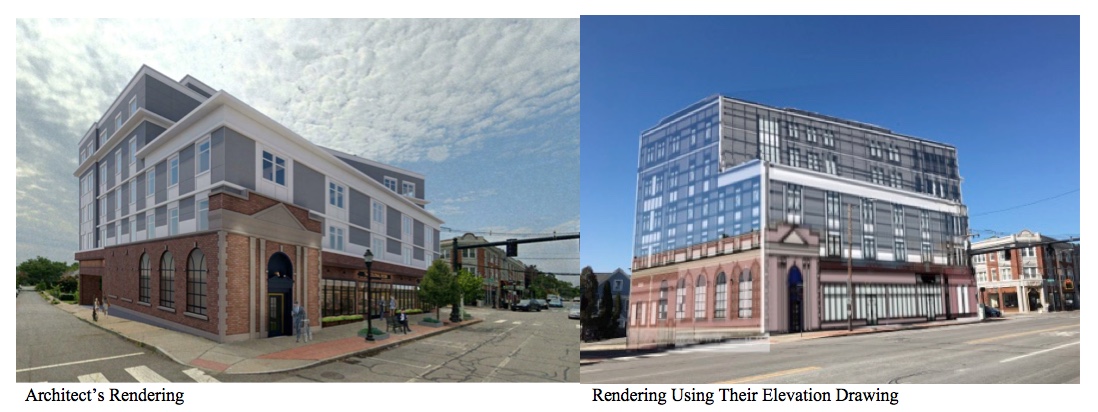


This project proposes to take an entire block of Capitol Square in East Arlington—at the heart of one of only three Village Business districts in town—and trim six businesses into just one, with an 80% reduction of commercial floor space.  While the project does comply with the Table of Use Regulations in the Zoning Bylaw, the extreme density proposed violates many provisions of the Bylaw.  The most serious of these is the Floor Area Ratio.  The maximum allowed anywhere in Arlington is 1.8.  The maximum for this B3 district is 1.5.  The proposal is asking for an astronomical 4.1.  


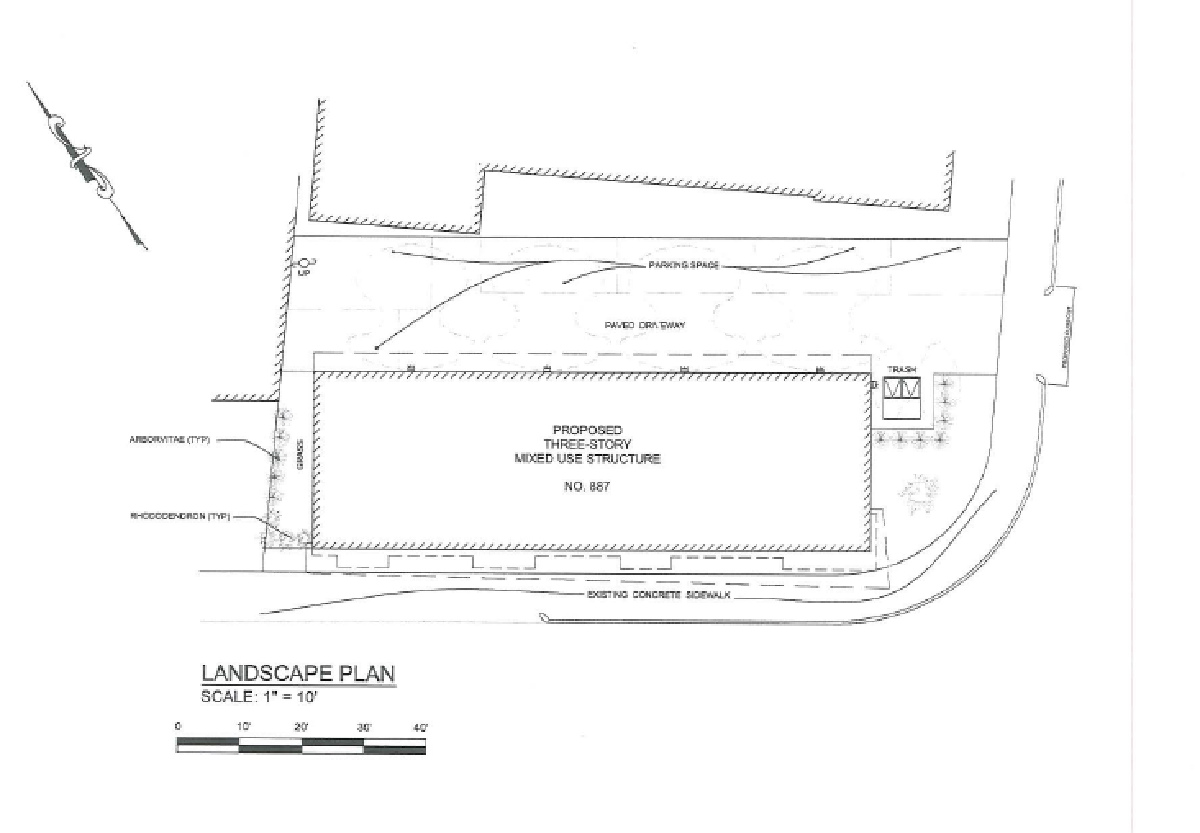
Arlington's Zoning Bylaw also requires that residential developments provide usable open space for those who will live in them.  For the amount of residential space in this proposal, at least 7,500 square feet would be required.  The developer is claiming a fourth floor roof deck as open space, but it is too high to meet the definition of useable open space, and doesn’t come close to meeting the minimum required square footage.  


Of particular concern to residential abutters, the proposal indicates an upper story stepback on the Mass. Ave. side only, although this stepback is also required on Lake and Chandler Streets.  As the former chair of the ARB noted, this provision of the Bylaw is intended to reduce "the massing impact on people utilizing the street, people utilizing the sidewalk. It makes buildings feel smaller than they actually are. … it gives the people who live here in town security that what's going to be built isn't going to be some monolithic monstrosity…”


If Arlington has a best-loved area, Capitol Square is a top contender.  Its appeal lies in the pedestrian-friendly mix of small businesses and eateries, so that the on-the-ground experience is of many unique and enticing small storefronts.  The Theater itself, on the National Register of Historic Places and approaching its centenary, is a living example of how the past can remain relevant when physical structures are maintained and uses are aligned with a community. 


But, along with ignoring our Bylaws, the architects seem not to have studied the physical and social environment into which they are proposing to drop this bomb.  By replacing four or five storefronts with one long uninterrupted street-level façade, they are ignoring the nature and uses of the area.


Both the design and the materials are alien to this block, completely lacking in interest, originality, or consideration of the surroundings.  It is the epitome of lazy architecture.  At the April 5 hearing on this project, in response to Board requests for more-appropriate exterior cladding, the project manager commented that masons are very hard to find, and brickwork expensive.  The project team might take a look at 483 Summer St., where a three-story mixed-use project with brick skin was recently completed, apparently without undue financial distress to the developer. 


The Capitol Square property owner also owns the block on Medford St. opposite the Regent Theater, home to Gail Ann’s Coffee Shop, La Victoria Taqueria, the Artful Heart Gallery, and other beloved small businesses, and it’s likely that there are plans afoot for redevelopment there.  It’s extremely important for the ARB to create greater understanding with him and his team for what is allowed, and for what is suitable.  His attorney’s threat of a 40B project in Capitol Square, if the ARB doesn’t approve the zoning violations his clients seeks, speaks clearly to the current lack of interest in either.


This project represents a wedge, in terms of how our town could be transformed when profit and cost-cutting take precedent over long-term outcomes.  It also represents the way that a single developer can re-shape our shared community, to its detriment, and to his or her gain. 


With some thoughtful design, as well as consideration for its setting, it has the potential to preserve the number of retail spaces, adhere to stepback requirements, comply with the zoning bylaw limit on floor area, and be designed in such a way that it both fits and enhances the area.  It’s to be hoped that an awareness of these possibilities will be apparent in the next set of plans and renderings.  


Thursday, March 18, 2021

In Search of the Public in the Arlington Redevelopment Board’s Public Hearings


Several members of the public were not allowed to speak at the March 1 public hearing for this proposed development at 10 Sunnyside Ave.


As the membership of the Arlington Redevelopment Board (ARB) and Town Planning Staff have undergone a nearly complete turnover in recent years, it is appropriate to consider how the board is conducting its Special Permit public hearings.

As demonstrated by its March 1, 2021 meeting, the board is simply not allowing enough time on its agenda for its Special Permit hearings.  Two Special Permit hearings were scheduled for the first 45 minutes of the meeting, when an hour was not even sufficient for the first hearing.  This should have come as no surprise to the ARB, as first one was a significant, new proposal.

The solution proposed by the chair to those members of the public who were denied the right to speak during the hearing—to offer comments during “Open Forum” later in the meeting or to provide written comments—is no solution at all.  Public hearings are held to provide the public the right to be heard, and the testimony of the public is to be on the record during the hearing process. 

The ARB chair does not get to pick and choose who can present testimony during the hearing. Under Massachusetts law, all members of the public have the right to be heard during a zoning hearing. Among those members of the public denied a chance to speak on March 1 were representatives of the Disability Commission, who should have the opportunity to weigh in on all projects in the planning stages in order to accommodate their needs.


The ARB and staff that support it clearly don’t understand the intended role of the public in public hearings. This is true not only in their willingness to conduct hearings as if they are proforma presentations by developers with predetermined outcomes, but also with their willingness to engage in ex parte communications with developers that come before them for special permits. (An ex parte communication occurs when one or more members of the board meets or speaks privately with a party to the special permit outside of the public hearing.) 

It is widely acknowledged that ex parte communications with those appearing before planning boards like the ARB are inappropriate even if not explicitly prohibited by law. Yet unlike other towns which ban the practice, the ARB actually defends it, and has refused to address it in its rules and regulations.


One attorney on the ARB has even made the astounding claim that private communications between a developer seeking a special permit and members of the ARB are not ex parte because the applicant (developer) is the party to the special permit—as if there were no other parties, such as abutters who might want to hear those conversations as part of the public hearing.


As currently managed by town staff, the ARB increasingly puts the interests of developers over the public interests. This is reflected not only in the board's attempts to minimize public input but in its disregard of the requirements of Arlington’s Zoning Bylaw.

The ARB is supposed to be giving enhanced review to the Special Permits it acts on—through a process called Environmental Design Review (EDR). Instead, based on a politically motivated and legally untenable memo prepared by Town Counsel last year, it is using EDR to reduce the basic protections written into the zoning bylaw, such as the requirements for open space.


Where's the Open Space?  887 Mass Ave


If the ARB is going to disregard the public process and use EDR to weaken Arlington’s zoning bylaw in direct contradiction of the purposes for which EDR was established in the first place, it raises the question whether the ARB should even be in the business of granting Special Permits. It is too late to put that question to Town Meeting this year. But maybe next year, it will be appropriate.

Chris Loreti
Former Arlington Redevelopment Board Member and Precinct 7 Town Meeting Member

Sunday, March 7, 2021

Giving Away the Store: What's Happening to Our Business Districts and Job Opportunities?


Recently several residents have posted to the Arlington List that Arlington cannot “develop enough commercial base to really make much of a difference.”  Actually that is completely wrong — we do have plenty of commercial/industrially zoned land — 43 acres of it to accommodate a good number of start ups, health specialties, life sciences, service sector,  biotech and software companies etc.  Plenty to bring excellent high paying jobs and internships although not huge amounts of commercial taxes.  What we don’t have is enough available land, partly because those who own many of the 43 acres of industrial parcels are land hoarding, waiting for the coming changes going to do away with protective zoning.  This cannibalizing and land banking of the industrial districts is planned by the Town Manager and Planning Director, to allow residential building in the industrial sector for exploitation by residential developers.  They cannot succeed if Town Meeting refuses to approve such damaging zoning.


These slides show why our business districts are so important: 

https://drive.google.com/file/d/17hn1nW_pBsGL6j7JXceQrhmBicY08xSd/view?usp=sharing


Arlington has very nearly reached the statutory goal for 40B compliance of 1.5% of buildable land for affordable residences, which would make us exempt from 40B projects.  40B projects have almost zero benefit to low-income residents.  40B developers can and do ignore our zoning protections and wreak havoc on the environment and town and school planning.  Nevertheless the Planning Director neglects to help the Town reach that 1.5% goal, and instead pursues the alternative goal of 10% of total housing units required to be affordable, while encouraging 40B development.  


That goal is inappropriate for land-poor Arlington.  It would cause massive displacement of low-income tenants due to demolition of existing naturally affordable housing.  It would demand between 3,000 and 6,000 or more new units if 40B projects were built to reach the 10% “affordability” goal.  (The exact numbers required depend on parameters in place at the time of calculation).  If we were to allow 40B projects on all our industrial land, parks, and open space, and add many high towers, the Planning Director could reach her 10% goal for Arlington.  Or, alternatively, well over 10,000 new units would have to be built if inclusionary zoning projects alone are used to reach the 10% goal.  See what could happen here:

http://rindge.arfrr.org


No one expects a large company like Moderna to plop down its headquarters in Arlington.  Arlington does not have that kind of campus land.  What it does have is 43 acres of industrially zoned land ideal for many small energetic companies and startups.


These slides show the kinds of small businesses we have, and what we might hope to attract: 

https://drive.google.com/file/d/17nGY6SniYXMicdR2DC-TJnJns7bRz--w/view?usp=sharing


For many years such companies have failed to find accommodation in Arlington and have found no help from the Town even for vacant properties.  I am familiar with some of these companies, but the example I know best is that of our son.  He needed only about 3,000 square feet of industrially zoned property but was told there was nothing of that size available at the time in Arlington.  He could not wait indefinitely to start since there were other M.I.T. students who were graduating and hoped to join him.  And so he found a small commercial property in another town.  Venture capital is not easy to put on hold.  His company went on to make some of the best equipment in his field in the world supplying international markets.  Although small, it provided many jobs at all levels, always with health benefits and local education initiatives and internships — one of their early Northeastern University interns eventually became the company’s Chief Scientist.  This exemplifies the kind of loss that our leaders are continuing for Arlington.   


Arlington’s Town Manager is in a good position to influence land use and housing policy.  His Arlington position and very high salary (higher than the Governor, or Mayor of Boston) has enabled him to move out of Arlington (already very dense at second densest Town in Massachusetts) to a large home and spacious grounds in a distant, less-crowded town.  And so he and his family will not be affected by the dense zoning he favors for Arlington.  Arlington taxpayers have supported him in his meteoric rise to leadership roles in various municipal or regional organizations.  Under his leadership as Chair of the Massachusetts Municipal Association the protective role of that organization for local zoning is gone.  Arlington will no longer be safeguarded by MMA from rampant zoning changes desired by the Manager and also by the Governor to reward his developer donors.  


https://www.bostonglobe.com/2021/02/02/opinion/governors-bill-does-little-affordable-housing/


And so will we lose our industrial land with its potential for commerce and industry, our open space, and our existing, affordable apartments, to real estate investors and residential developers?  Will we accept this loss, along with escalation of taxes, overcrowding of schools, increased homelessness, and displacement and eviction of low-income residents of all races — removed to make way for new lucrative residential construction? 


Or will Town Meeting stand up to prevent this loss?


Patricia B. Worden

Town Meeting Member, precinct 8


Read more at “Developers’ Dream,” at: 

https://blog-arfrr.blogspot.com/2021/02/the-developers-dream.html


Thursday, February 11, 2021

The Developers' Dream

Some Notes on the Economic Development Bill


Over the years, Governor Baker’s attempts to end local control and open up the region to greatly increased development have taken many forms, Bill numbers, and names (most ironically, the Act for Housing Choice), and until now have always been defeated.  The latest version, the Act Enabling Partnerships for Growth, finally passed.  Zoning-related changes that had failed time after time on their own merits were here combined with other economic proposals and pushed through, during a global pandemic, in a great boon to the development industry.

https://malegislature.gov/Laws/SessionLaws/Acts/2020/Chapter358


 East Arlington, 2021


How Is The Bill Likely to Affect Arlington?

·      Changes to Required Vote for Zoning Proposals

One of the more significant changes is abolishing the current 2/3 vote for zoning changes and replacing it with a simple majority vote.  The 2/3 vote has a long history, and is considered an important check on hasty passage of proposals that have long-term and difficult-to-reverse consequences.  Communities use it to make sure that zoning changes are well considered, and have the support of more than a simple majority.  This change will make it quicker and easier to enact zoning changes—but will continue to require a 2/3 vote to reverse them.  (In a fine example of "Do as I say, not as I do," Baker has chosen to retain the traditional 2/3 vote required to override his own vetoes …)     


·      MBTA Community Overlay Districts 

The Bill includes a mandate for so-called MBTA communities to change their zoning in areas within a half-mile radius of certain public transportation hubs.  An MBTA community that fails to comply will not be eligible for various state funding sources: the Housing Choice Fund, the Local Capital Projects Fund, or the MassWorks Infrastructure Fund.  In our case, that hub is the Alewife MBTA station.  (It’s unclear if the Arlington Heights bus depot will be considered an MBTA hub.)  This means that the area shown in the map will be required to allow three family houses or denser by right, and a density of at least 15 units per acre. 


Since the designated area of Arlington already exceeds the 15 unit per acre requirement, with approximately 17 units per acre, our Redevelopment Board needs to figure out how to meet this mandate.  The penalty of funding ineligibility doesn’t kick in until next year, so the ARB has voted to delay any action at this year’s Annual Town Meeting while they study the issue.  But our Department of Planning and Community Development has already drafted an amendment to our Zoning Bylaws that meets the MBTA mandate more than half-way by proposing dimensional changes not required by the mandate, that would do away with minimum lot areas and frontage, all front and side setbacks, and open space. Four stories and 40 feet height in this area would now be allowed.  This could mean the sacrifice of the small businesses that line Massachusetts Avenue in the half-mile radius area, as well as the transformation of the R2 housing in this flood-prone area into an extremely dense semi-urban zone.


·      ADUs By Right

A proposal to allow Accessory Dwelling Units by right in one- and two-family homes will only need support from a simple majority of Town Meeting, instead of 2/3 of those voters.  There are many issues of enforcement to be worked out, as well as how to protect neighbors, what effect this would have on property values, infrastructure, parking, etc., not to mention that this is essentially a back-door means of eliminating single- and two-family zoning.  And, per the Bill, it would still require a 2/3 vote to reverse if the Town later determined that adverse effects were significant. 


·      $50,000 Bond for Special Permit Appeals

This is a somewhat mystifying section of the Bill, and extremely punitive for citizens attempting to appeal Special Permit decisions.  It will allow a judge to require “a party appealing a decision to approve a special permit, variance, or site plan to post up to a $50,000 bond to secure the payment of costs if the court finds that the harm to the defendant or to the public interest resulting from delays caused by the appeal outweighs the financial burden of the surety or cash bond on the plaintiffs.” 


This requirement will almost certainly put an end to appeals, even though in Arlington we have had only one such appeal in the last year. 


What Is This Bill About?

·      It’s About Removal Of Local Control

When the 2016 version, the Act Promoting Housing and Sustainable Development, was being deliberated, even the Executive Director of the developer-friendly Massachusetts Municipal Association argued against allowing expansion of by-right projects, and said, 


·      It’s Not About Climate Resiliency

Baker vetoed the climate provision of the Bill, citing the possibility of increases in the cost of housing, possibly preventing the construction of affordable developments, and potentially having adverse affects on large sectors of the economy.  This, even though the bill has won the backing of environmental groups who criticized his decision to veto the measure.


·      It’s Not About Affordable Housing

Despite its promises, the Bill fails to require any realistic mechanisms to provide affordable housing or prevent destruction of existing “naturally occurring” affordable housing.  The provisions to encourage affordable housing only require it to be an anemic 10% of various projects, meaning 90% of new housing will be at market rate.  The need in the Commonwealth is for housing for low- and moderate-income people.  The luxury market is doing just fine without help from the state.  It would also make affordable housing available at 80% of Area Median Income, even though when wealthier communities are included in the calculation, this can mean eligibility includes families with 6-figure household incomes. 


Of the 2017 version, Rep. Mike Connolly of Cambridge noted: “Governor Baker introduced H.4075, An Act to Promote Housing Choices, on December 14, 2017. Astoundingly, the text of the bill is seven-pages long and yet does not include any of the following words: affordable, affordability, tenant, or displacement.”  In the 2021 version, Baker went so far as to veto tenant protections from evictions, and a provision for allowing tenant participation in the purchase of their rental properties. 


For an incisive comment on the vacuum of affordable housing initiatives, and underlying causes, see this letter to the Boston Globe: 


This online version of the letter contains a number of useful links:

https://www.bostonglobe.com/2021/02/02/opinion/governors-bill-does-little-affordable-housing/


Friday, January 22, 2021

2020: The Very Bad Year - and we're just talking about redevelopment

Welcome to 2021, which we all hope will be a lot better than 2020.  Here’s a review of that memorable year, from Arlington Residents For Responsible Redevelopment: 


Density, Bylaw Votes, and Town Meeting

  • After years of attempts, the developer lobby was finally able to abolish the required 2/3rds supermajority vote for zoning bylaws, replacing it with a simple 51% majority vote -- but only for those laws that facilitate the state-wide pro-density/urbanization push that developers have been hoping for.  The 2/3rds vote will still be necessary to reverse any zoning bylaws passed under the new law, making it extremely difficult to change course once negative results become apparent.  Governor Baker is expected to sign this into law in early January.  

  • Arlington’s April Town Meeting was limited to essential business only, as we sank into Covid-19.
   
  • Several pro-density citizen's Articles were carried forward to Special Town Meeting in November, as an all-out attack on the single-family home.  Town officials appeared to look favorably on these, including an accessory dwelling unit (ADU) proposal lacking in any protections for neighbors, and despite the fact that ADUs were rejected by Town Meeting a year ago.  Worse, a proposal to remove all single-family zoning received serious attention, and was falsely touted as redressing historical racism.   

 These Articles were defeated at Special Town Meeting, based on their lack of merit.  Density    Articles may come back in 2021, as the Town Manager and Planning Department support urbanization and greater density for Arlington.  They have even incorrectly linked such steps with fighting racism, despite research showing that density without significant affordability requirements shuts out minority and lower- and moderate-income residents.

 As always, ARFRR is working to let the public know about these and other proposals, which threaten affordability, climate resilience, and more. 


Redevelopment Board and Zoning Board of Appeals News

  • The former chair of the Arlington Redevelopment Board (ARB) resigned and Member Rachel Zsembery became Chair.  A new member, Dr. Katie Levine-Einstein, was appointed.  Dr. Levine-Einstein has produced research and a book, "Neighborhood Defenders,” asserting that public oversight and participation in American municipal boards is restricting progress.  (Dr. Levine-Einstein resigned in early January 2021.)

  • During the summer, the Redevelopment Board decided that it was Above the Law, the Zoning Bylaw, that is.  An attorney for a developer argued that the Zoning Bylaws passed by Town Meeting were actually guidelines, but not strict rules.  The argument went on that the Board had the authority to bend, break, or simply ignore any Bylaw that they found inconvenient.  The majority of the Board embraced this interpretation of their powers enthusiastically and immediately began exercising this newfound authority to ignore half a dozen Bylaws that were inconvenient for the developer.  The Board is now allowing multiple projects under this new dispensation. 

  • The chair of the Zoning Board of Appeals resigned, following a criminal charge.  A Member, Christian Klein, was elected Chair. 

  • A dozen residents sued the Redevelopment Board for improperly applying the Mixed Use Bylaw passed four years ago by Town Meeting.  Town Counsel argued that the statements defining the scope of the law made by two Board members during the debate on those Articles carried no legal weight.  He characterized their statements as simply off the cuff remarks by two people, to be given no more consideration than those of anyone else who speaks at Town Meeting. 


Any future such appeals will likely be curtailed by the provision in Governor Baker's Partnership for Growth bill which requires a $50,000 cash bond for special permit appeals. 


The Very Bad Year, in ARFRR Blog Posts

...You can see all the 2020 posts at: https://blog-arfrr.blogspot.com/2020/ 

The Hotel Lexington situation:

February:  The Heights Hotel Part V - What is Wrong with this Picture? 

and:  The Heights Hotel VI - Jump Starting the Project

July:  They're Baaaack... - Hotel Lexington (VII) and the Toraya Block Tear Down

August:  Hotel Lexington - Learning the Rest of the Story


The old Toraya/ACMi block situation:

July:  They're Baaaack... - Hotel Lexington (VII) and the Toraya Block Tear Down

August:  Tossing out the Rule Book


Mugar and “affordable” projects progress, but won’t improve affordability:

April:  Mugar Update

August:  Q & A on the Mugar Wetlands / Thorndike Place 40B Project In East Arlington

October:  Moving the Finish Line


Zoning and the Government: lowering the bar to density and tossing out the rule book:

August:  Thousands Of Lamborghinis: Notes On The Housing Choice Bill
and:  Tossing out the Rule Book The New Normal - When Zoning Bylaws become Optional


Final Thoughts - And Some Good News...

  • As urban areas looked less attractive and “a little space” looked better, development pressures in Arlington have increased.  Developers have been demolishing older, smaller houses and building large new homes and additions.  The Good Neighbor Agreement (GNA), a Bylaw that requires new construction to be publicized to neighbors within a 200’ radius, has existed for several years, but is not always enforced.  It appears that Arlington's Inspectional Services is not aware of the issue.  Hopefully the public and the Town can work to enforce the GNA better next year.
  • And to close on a brighter note, the Design Review Working Group, along with Harriman Design, has drafted design guidelines for residential development.  Surveys, several public forums, and input from builders have all informed the work of the DRWG in creating these guidelines, which aim to provide guidance for more appealing siting and design of new houses and large additions. One builder commented that they will essentially offer free architectural advice to builders.  It is hoped that they will lead to residential development more suited to its surroundings, rather than the too-large, generic houses we see too often in town. 

We'll let you know how 2021 develops as far as redevelopment.  At the moment, it looks to be more of the same.

Carl Wagner

Saturday, January 2, 2021

Demolition of the Toraya Block, or It's Not My Problem


Updated January 13, 2021

First, a bit of history. 

In 2009, the Arlington Redevelopment Board granted a Special Permit to redevelop the auto dealership adjacent to the High School as a CVS store. The historic Atwood House, which was part of the parcel, was to be preserved. As stated as a special condition of the permit, 

 “The Atwood House shall remain at its present location on the site, and diligent efforts shall be used to maintain its present condition to prevent any damage from the elements or otherwise, until it is redeveloped.” 

There were also the usual stipulations regarding obeying town bylaws and snow removal from the adjacent public sidewalk. 

For the next decade all of this was forgotten. The Atwood House was neglected, frequently broken into, and badly vandalized. It became not just an eyesore, but a public safety concern due to its use as a drug den. And for that decade, the sidewalk remained uncleared every winter. Pedestrians trying to reach the CVS store, bus stop passengers, and high school students often had to divert out onto Mass Ave to get by.

 It only came to the Redevelopment Board’s attention in 2019 when CVS applied for a change of signage. Awakened to the fact that it still held jurisdiction over the property, the Board summoned the absentee owner of the Atwood House to explain the situation. There was a lot of hand-wringing, voiced regrets, but no consequences for the negligence. 

The Board felt powerless to do anything at this late date. But now history is repeating itself, just two blocks away, right across from the High School. Earlier this year the Board granted a Special Permit for the redevelopment of the Toraya Block. It was presented to the Board that the site had suffered toxic contamination due to negligent behavior on the part of a past tenant and needed to be entirely demolished for remediation. 

The proper course of action would have been for the developer to present a plan to the Arlington Health Department for the safe demolition of the building, taking into consideration not only the toxic contamination of the building and the soil, but also the asbestos present in the structure, and the likelihood of lead paint. Taken into account would be the adjacent residential properties and the high pedestrian traffic including school children.  Once the Health Dept signed off on the plan it would go to Inspectional Services for the necessary permits. The Good Neighbor Agreement package would be sent to all abutters within 200 feet, at least a week before any demolition began, according to our bylaws. 

None of that happened, and a public safety hazard was created instead. On October 26, the developer filed a notification with the State Department of Environmental Protection of its intention to remove asbestos from the interior of the building. It began this work the first week of November. The work went far beyond asbestos removal. It included significant exterior demolition of the roof top and gutting of interior walls. The debris from this demolition was simply piled up in the rear parking lot in several very large mounds and left unsecured. Much of this work occurred in the dark of night, well after legal working hours. No local permits were sought, nor was the Health Dept advised that it was taking place. 

Piles of Debris

 
A Third Pile of Debris
 

 Something went wrong with the demolition and parts of the front facade of the building began collapsing onto the front sidewalk by the bus stop. Town employees moved in quickly to secure the area with fencing. 


Fenced Off Collapsing Facade

 For the next month there was no observed activity on the site. The piles of unsecured debris were left in the parking lot, free to blow around. Inspectional Services was not very responsive to inquiries. Because no permits have been applied for, they redirected questions to the State DEP.   The Health Dept was completely unaware of the situation until notified by residents in early December. Their response was to drive by the site and observe from the street. They did not contact the developer and have advised residents to redirect any questions to either ISD or the State DEP. 

As a result of resident complaints about the situation, the Town Manager did task the acting assistant Town Manager with determining what was going on. The developer did eventually cart away at least three large dumpsters of debris. Several large steel drums with mystery contents remain. It is not known what was in the debris, nor when work will resume and the required demolition permits will be applied for. The neighbors remain in the dark and are still awaiting the required Good Neighbor Agreement notice. 

For two months now the emergency fencing has remained up on the Mass Ave sidewalk with no indication of when the developer intends to make the building or sidewalk safe again.  It took several years for the Atwood House to become a blighted eyesore and public safety hazard.  The Toraya Block managed to reach that infamous status in just a few weeks.

And after each snow storm this year, the remaining sidewalk along the block has been left uncleared, forcing pedestrian, bus passengers, and students to once again step out onto Mass Ave to get by.

Three Days after the Storm


 The Redevelopment Board retains jurisdiction over the site through the recent Special Permit and this time it has the leverage to do something about the problem. The developer appears before the Board this Monday evening (January 4) asking for another Special Permit. It is the Board’s obligation to use this opportunity to question the developer and get some real answers as to what is happening at the Toraya Block site, the plans to correct it, and why town bylaws are being ignored. It is the Board’s chance to redeem itself and not repeat the lapse of responsibility of a previous Board a decade ago.

When the Board granted a Special Permit for the Toraya Block, it included the condition that the Board would maintain "continuing jurisdiction over this permit" including taking such actions "... as it deems appropriate in order to protect the public interest and welfare."

Apparently these were empty words.  The response of the Board Chair to this situation is

Please direct all questions and concerns regarding the demolition of the property and the safety of the site during construction to the Building Inspector.  Please direct all questions and concerns regarding snow removal to the Select Board. I have contacted Chairperson Hurd about previous concerns regarding snow removal at this site. These are the two entities with oversight authority for these two issues that you have raised.


Lockeland Side Snow Clearance


Update January 13, 2021

Heavy construction equipment was seen on the lot for a few days earlier this week.  This prompted a resident to inquire if the Health Dept had done the necessary review prior to the demolition of a hazardous waste site. The response was that the developer had reached out to the Health Dept to begin the application process, but the Department still did not know anything more than it did a month ago about what earlier work had been done.  Coincidentally, the heavy construction equipment quickly disappeared from the site.

The developer has since responded to this Blog.  Not to provide any helpful information, or to challenge any of the facts presented, but instead in the form of an angry letter from his attorney suggesting that the photographs were taken by means of illegal entry onto the property.  Apparently the developer imagined that a septuagenarian had climbed over a six foot chain link fence to take those photos shown above.

The photographer wishes to assure the developer that:

He has not scaled such a fence since before Nixon was President.

He would not willingly step onto the hazardous waste site.

All photographs were taken from the relative safety of the public sidewalk.


Written by Don Seltzer